

System Shift Series: On Ashumet Pond, Everything is Connected
Published on: June 1, 2026
System Shift is a new story series focusing on Cape and Islands homeowners who have I/A systems and/or are practicing alternative ways of dealing with human waste. The series also puts a spotlight on pioneers in the world of advanced treatment. What’s it like to have an I/A system? How does it help the local mission to be better land and water stewards? We’ll tackle these questions and more in hopes of helping “shift” the way we see all the moving pieces of Cape Cod’s wastewater puzzle.
By Amy DuFault, MASSTC Communications
Janet Kluever doesn’t seem like the kind of person who would casually upend one of the most culturally entrenched rituals of modern American life but she is, one toilet use at a time. In fact, her Phoenix composting toilet is composting all of her waste and over years, making it into a healthy fertilizer she can use for her plants and away from, and out of, Ashumet pond.
And it’s good she’s doing this. Ashumet Pond which covers both Falmouth and Mashpee, sits a few hundred feet from her back door and is suffering a fate many other freshwater bodies across Cape Cod are: a slow death. The pond, slowly slipping into environmental distress summer after summer, its waters increasingly interrupted by cyanobacteria outbreaks, makes swimming, canoeing, fishing and even letting one’s dog drink from it, feel more like a gamble courtesy of all the bacteria.
Ashumet Pond, straddling the towns of Falmouth and Mashpee, has a documented history of harmful cyanobacteria (blue-green algae) outbreaks fueled by high nutrient levels (primarily phosphorus), from surrounding development, failing septic systems, and historical wastewater disposal.
Kluever has been watching it happen for years.
“I’ve watched it degrade since I moved here,” she told me recently, as we sat quietly on her couch looking out the slider at fog hanging over the pond.
“I love swimming,” she said. “I used to swim across the pond, but I wouldn’t do that now with how many cyanobacteria outbreaks we’ve had.”
Cape Cod’s freshwater crisis has become increasingly difficult to ignore. Nutrient pollution, much of it from septic systems, feeds toxic algal blooms and degrades ponds, estuaries, and coastal ecosystems. Cape Codders continually vote at town meetings in favor of supporting multimillion-dollar sewering projects while homeowners are increasingly being asked to support it with their tax dollars. Most homeowners aren’t even aware there are options, they simply want the problem to go away and aren’t even sure how we got to this tragic tipping point.
For Kluever, the answer arrived unexpectedly during a visit to The Green Center, a small nonprofit promoting ecological sanitation systems.
“When I met Hilda and Earle at The Green Center, it was like lightning hit me,” she said. “I thought: this is exactly what we need to do so we don’t harm the pond.”
Her husband had heard about the organization first. They toured the facility together, and Kluever walked away convinced composting toilets weren’t fringe technology at all.
“I felt immediately that this was the solution,” she said. “It helps us save water and helps us from creating wastewater.”
That last distinction matters. Traditional wastewater systems are built around dilution: we mix human waste with gallons of perfectly clean drinking water and then spend enormous amounts of energy trying to separate it again. Ecological sanitation flips the logic entirely.
“We’re peeing in clean drinking water and not thinking anything of it,” Kluever said, sounding genuinely baffled.
For decades, Ben Goldberg, founder of Flower Potties, has installed and maintained composting toilet systems in private residences, businesses, and public facilities across New England. He remembers the Kluever installation well, not because it was easy, but because it reflected the kind of curiosity and commitment ecological sanitation often requires.
“It was a pleasure working with Janet and Rolf,” Goldberg said. “Both were hugely hospitable and accommodating, and as engineers, curious about the technology.”
The retrofit itself was unusually complex: a dry toilet on the first floor and a urine-diverting flush toilet upstairs, all connected into the Phoenix system below. The upstairs fixture was a Dubbletten UD flush toilet, a now-discontinued model that separates urine at the source before diverting it into the composting system.
“The basement access was tight,” Goldberg recalled. “We had to shoehorn the Phoenix into position and snake the second-floor urine line through a circuitous pathway.”
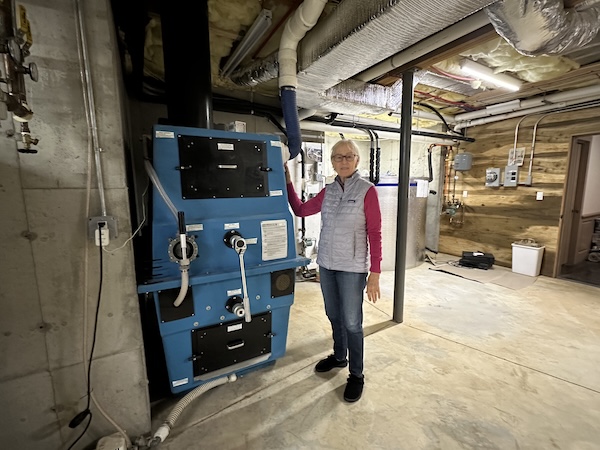
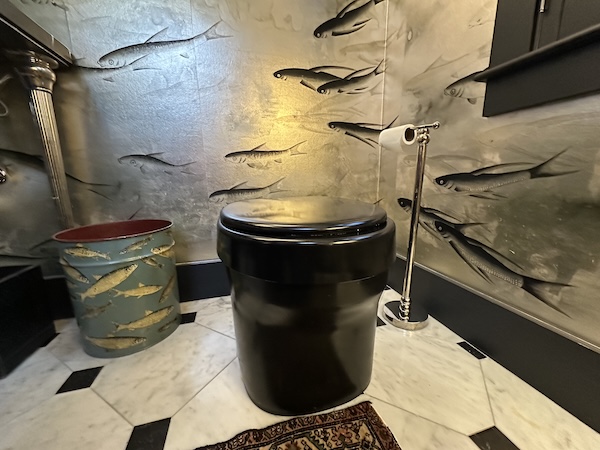
Even now, he sounds impressed by the collaborative spirit behind the installation. Rolf monitored the system meticulously. Janet was fascinated by the nutrient recycling potential for gardening and farming. A local plumber managed the logistical gymnastics required to make the whole thing work.
Conor Lally, founder of Nutrient Networks, has worked on the Kluevers’ system for years through the company’s inspection and cleaning program, which helps homeowners maintain ecological sanitation systems that often require only periodic servicing.
“I consider Janet and her late husband Rolf some of the early adopters and pioneers that advocated for the use of eco toilets on Cape Cod,” Lally said.
Most composting systems, Lally says, require annual inspections, though some homeowners occasionally need additional assistance. Removing compost from a Phoenix unit is generally necessary every one to five years depending on usage.
“It’s about three-quarters of a yard of woody compost,” he said. “We’re happy to do that for folks getting up in years and who may not want to perform the task themselves.”
Kluever’s maintenance routine is simple. Each time the Phoenix is used, a handful of wood chips is tossed into the toilet. Once a week she goes downstairs and turns a crank to mix the contents. She has only had to empty the contents twice in 10 years.
“Hardly a hardship,” she laughed.
The finished compost is eventually removed and used around the property on ornamental plants, part of a nutrient cycle ecological sanitation advocates argue should never have been broken in the first place.
The process sounds unsettling to some people mostly because Americans have been conditioned to view waste as contamination rather than material. Ecological sanitation asks people to participate, however minimally, in the reality of their own nutrient cycles. And participation makes people uncomfortable.
“So many people get disturbed by an in-house outhouse,” Kluever said. “But it’s so easy to have a composting toilet, and the benefit is getting fertilizer from the system after it composts for a few years.”
Her friends, she says, are supportive, but not necessarily ready to install a composting toilet themselves. Which is a behavior that’s on trend when it comes to environmental issues. Consider the National Center for Science Education reporting “over 70% of Americans understand global warming is happening, but our deep-seated reliance on convenience, consumerism, and ingrained cultural habits creates a severe barrier to making intimate, everyday behavioral changes.”
But Kluever believes that once you start focusing on wastewater, it becomes difficult to stop thinking about other environmental challenges.
“Once you start considering wastewater,” she said, “it’s like pulling a thread and seeing how one thing is connected to the other.”
Got a story you want to tell about your I/A, composting or urine diversion system? Email Amy at contractor-amy.dufault@capecod.gov


Distribution channels:
Legal Disclaimer:
EIN Presswire provides this news content "as is" without warranty of any kind. We do not accept any responsibility or liability for the accuracy, content, images, videos, licenses, completeness, legality, or reliability of the information contained in this article. If you have any complaints or copyright issues related to this article, kindly contact the author above.
Submit your press release